
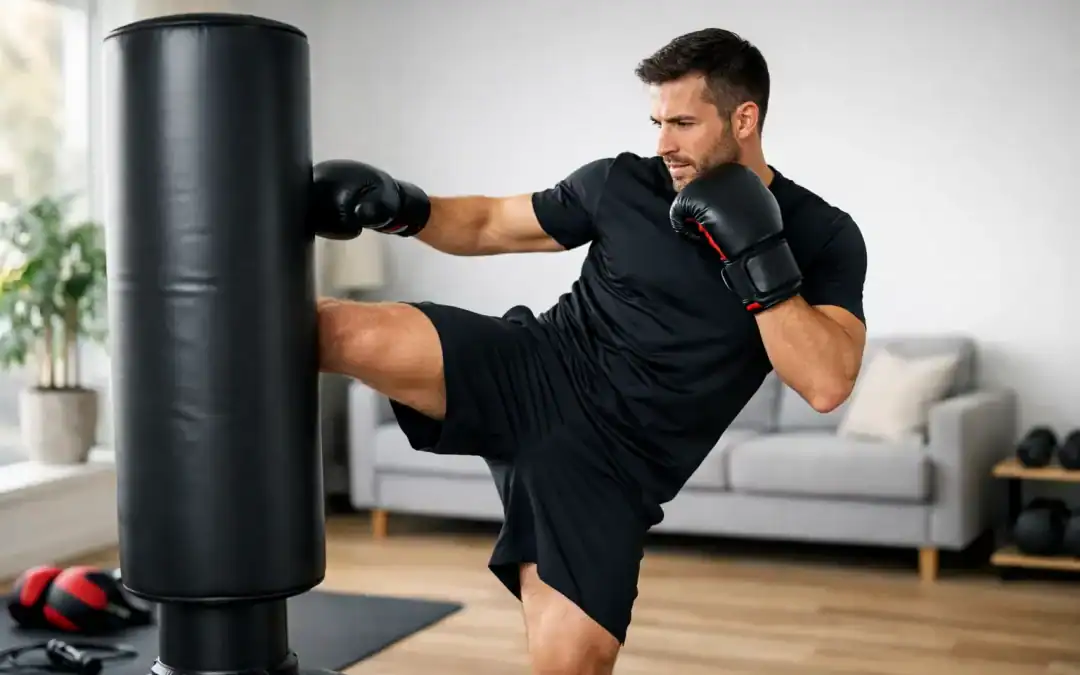
He who only kicks wildly at home trains movement. He who Improve kicking technique takes it really seriously, trains control, distance, timing, and clean hit patterns. That's exactly where engagement separates from progress.
Why kickboxing technique training at home often stagnates
The problem is rarely motivation. Most people fail due to training quality. Without a partner, without a clear vision of the goal, and without direct feedback, mistakes creep in: the hips open too early, the standing leg doesn't rotate cleanly, the kick is dragged instead of snapped, or the distance is off during the strike.
It's often barely noticeable on the punching bag. The bag forgives a lot, absorbs energy, and gives you resistance but hardly any precise feedback on the hit area, timing, or return. It's useful for conditioning. However, it's only moderately useful for clean technique training.
When technology makes the difference, you need a structure at home that makes movements measurable and repeatable. This is exactly where Kickboxing training at home really effective.
Kickboxing technique training at home needs three things
Technical training also works without a training partner, but only when three factors come together: a clear technical goal, controlled repetitions, and a training tool that not only enables contact but also promotes clean execution.
The first goal should never be „kick harder.“ More sensible goals are specific tasks such as: hitting a roundhouse with a stable axis, executing a front kick with a quick retraction, or landing a sidekick with clean execution.
The second point is control. Good technique arises when the movement remains stable.
The third point is feedback. Classic tools like pads are effective but require a partner. A punching bag is available but primarily trains toughness. For timing, precision, and control, modern kick training equipment often the better solution.
This is how you build a meaningful unit
1. Prepare movement patterns
Start with footwork, mobility, and controlled kicks. Not exertion, but alignment.
2. Set a kick focus
Train in clear blocks. Those who constantly switch get no depth. Structure is crucial.
3. Sharpening timing and feedback
Many kicks look good, but then fall apart. This is exactly where training separates from progress. Systems like the Tornado training device help train timing and recall cleanly.
4. Increase speed at the end
Speed comes from clean mechanics. Those who accelerate sloppily train mistakes.
This is where it also becomes clear why good training is closely linked to Reaction training in martial arts is connected.
What home workout mistakes slow you down the most
Aimless volume, too much hardness, wrong distance, and a lack of feedback.
Many train a lot, but not with a specific goal. Quality beats quantity.
Which equipment is really useful for home
The punching bag is good for toughness. It gets trickier for technique.
Anyone training alone needs solutions that combine movement and purpose. That’s precisely why specialized systems like Tornado Systems or the Speed Master meaningful.
You make training not only more intense but also more precise.
The same does not apply to beginners and advanced learners.
Beginners need clear patterns. Advanced players need precision and timing.
Both benefit from more structured training.
How to recognize real progress
Progress is shown not in exhaustion, but in control.
Cleaner hits, more stable retrieval, better series.
When specialized training solutions are worthwhile
If you regularly train alone and notice that you're missing feedback, the next step makes sense.
Modern systems close exactly this gap – especially when compared to classic equipment.
In the end, it's not how spectacular your training looks that counts, but how precisely you work.