
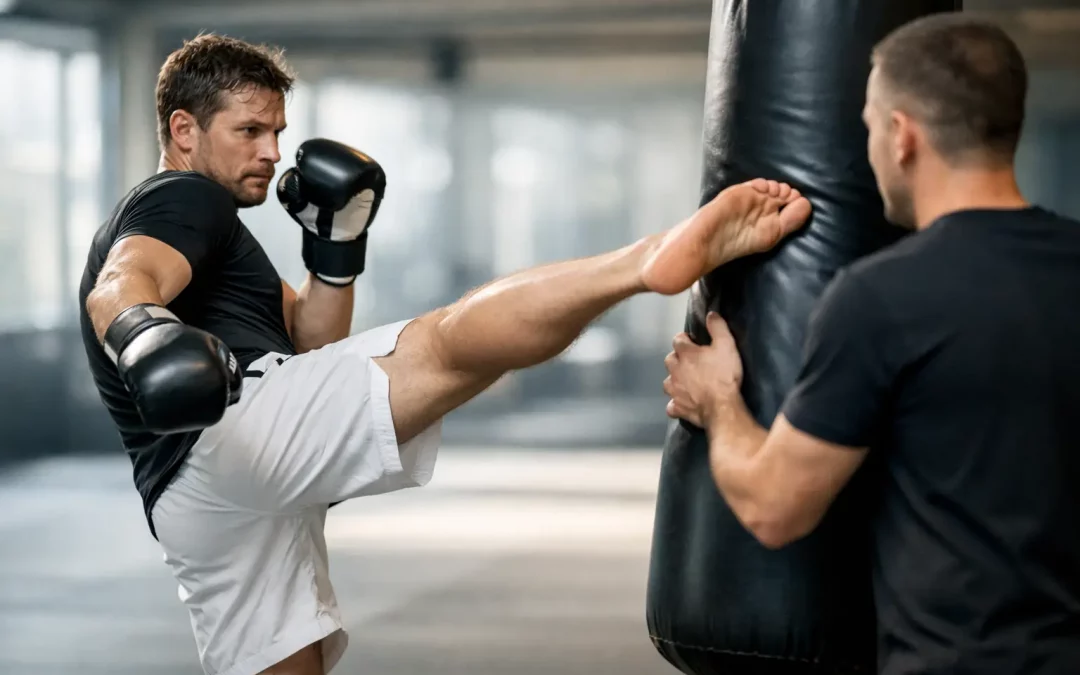
Anyone who often hits a beat too late in sparring knows the problem immediately: The kick is technically clean, but the timing is off. This is precisely what determines whether a technique is effective or misses its mark. Improving kick timing, therefore, doesn't just mean kicking faster. It means reading the right cues, choosing the appropriate distance, and acting at the exact right moment.
Timing in Taekwondo, kickboxing, and related disciplines is not a secondary concern. It's the part of the technique that turns a good movement into an effective strike. Many train for power, height, and repetitions. What's often missing is a setup designed for reaction, rhythm changes, and controlled execution. That's exactly where clean timing training begins – often with the right Kick training equipment.
What timing really means for a kick
Timing is often confused with speed. Of course, a fast kick helps. But a fast kick at the wrong time remains a bad kick. Timing consists of several building blocks that work together: reacting to a signal, judging distance, initiating movement without delay, and striking cleanly within the flow of movement.
You can clearly see this in competition. The difference between a hit and a counter often lies not in power, but in mere hundredths of a second. Starting too early betrays the technique. Reacting too late only results in hitting the opponent's guard or their retreat. When every hundredth of a second counts, training must bridge this exact gap.
Here's an additional point that many underestimate: timing isn't just important offensively. It also improves control in combinations, intercepting movements, and changing pace. An athlete with good timing appears calmer, even though they are working more dynamically.
Why classical training is often not enough
The punching bag and focus mitts have their established place. They are useful for toughness, rhythm, and basic technique. However, they quickly reach their limits when it comes to timing. The punching bag moves predictably or not at all. The focus mitts function largely through the partner. This can be very good, but it depends on experience, focus, and repeatability.
Just now during home workouts This leads to a typical problem. Without a partner, the real signal is missing. Without clear feedback, it remains unclear whether the kick only looked fast or truly came at the right moment.
Many improve your technology Visually, but not functionally. That's exactly why classic training is often not enough if you really want to improve your timing.
Improve kick timing with clear stimuli
Timing improves when training demands concrete decisions. A good drill doesn't just force you to kick, but to kick correctly at the right moment. This requires stimuli that connect the starting signal, the target movement, and feedback.
A fixed goal is rarely enough for this. Training methods where the goal reacts or changes are better. This is exactly where modern systems like the Tornado Kick training device because they combine movement, timing, and feedback.
Training is particularly effective when you simultaneously train three things: gaze behavior, reaction time, and accuracy.
What mistakes are slowing down your timing
The most common mistake is over-preparation. Many athletes visibly load up their kick and lose valuable time as a result.
The second mistake is incorrect distance. Even good timing looks bad if you constantly have to correct yourself.
Even monotonous repetition can worsen timing. If every repetition plays out the same way, you stop reacting – you just go through the motions.
This is how timing training should be structured
Good timing training doesn't start at full speed. First, the movement must be stable. Then, variable stimuli are added. Only after that does the whole thing become faster and closer to competition.
Solo kick before combination
Start with individual techniques like the roundhouse kick or front kick and work specifically on your timing there.
Variable incentive instead of rigid rhythm
Once the single kick is clean, you change the stimulus. That's exactly how your body learns real reactions.
After-hit check
Good timing doesn't end with contact. The decisive factor is the control afterwards.
Improve kicking timing at home without a training partner
It's difficult to train timing at home. Anyone training without a partner needs a system that allows for reaction – otherwise, it remains pure repetition.
This is where modern training equipment has the advantage. Instead of just working against resistance, you train for a specific moment. That's exactly why it works Kick training equipment much better here than classic solutions.
If you specifically want to train timing, it is Tornado Training System currently one of the most effective methods because it combines movement, reset, and feedback.
How to Really Recognize Progress
Timing doesn't just improve by making a kick look faster. You recognize progress by hitting cleaner, working calmer, and landing more strikes in sparring.
For coaches and clubs
Efficiency is key in club training. A good timing setup must work quickly and help many athletes simultaneously.
This is precisely where structured training equipment helps, as it enables independent training and increases the quality of each repetition.
Conclusion: Timing is everything
Improving kick timing is no secret. It's the combination of clean technique, clear cues, and repeatable feedback.
If you really want to improve timing, you need not only more training, but the right training.
→ Discover kick training equipment
→ View Tornado Training System
→ Improve kicking technique
→ Kickboxing training at home