
Those who want to learn taekwondo kicks at home quickly realize: A few high kicks in the air look like training, but often don't offer much technically. Without clear sequences, proper distance, and controlled repetition, mistakes creep in. This is precisely where it's decided whether home training is just exercise or if it truly improves your technique.
Learning Taekwondo kicks at home means more than just kicking.
In Taekwondo, it's not the number of kicks that makes the difference, but their quality. A Dollyo Chagi with poor hip rotation, an Ap Chagi without a clean chamber, or a Yop Chagi without a stable axis might look dynamic, but they lose precision, effectiveness, and control. This is often noticed later at home than in the dojang because direct correction is missing.
That's why your home training needs a clear priority. First comes technique, then speed, after that height, and only at the end hardness. Many train in the exact opposite way and wonder why their kicks are fast but sloppy. Control begins with technique.
The advantage of training at home is still great. You can build up repetitions, solidify movement patterns, and specifically work on weaknesses without being dependent on gym time or training partners. Especially with kicks, which rely on timing and feel for movement, regular short sessions are often more effective than infrequent long ones.
Which kicks you should train at home first
Not every kick is equally suitable for getting started in the living room, basement, or home gym. If you're training at home, you should first choose those techniques that give you a stable foundation. These primarily include Ap Chagi, Dollyo Chagi, and Yop Chagi. These three kicks cover central movement patterns: forward pressure, rotation, and lateral stability.
The Ap Chagi appears simple, but it's technically more demanding than many people think. Crucial elements are the clean lift of the knee, active foot tension, and controlled retraction. Anyone who is sloppy here will carry the mistake over into faster combinations later.
Dollyo Chagi is about more than leg swing. Your hips, standing foot, and upper body have to work together. If your standing foot doesn't pivot cleanly, you'll block your rotation and lose reach. You can practice this sequence very well by itself at home because you can fully concentrate on the line of the kick.
The Yop Chagi places higher demands on balance and body tension. For many athletes, this is precisely why they avoid it. This is a mistake. It's especially valuable at home because it shows you how stable your technique really is. If you buckle sideways or don't align your hips cleanly, you'll notice it immediately.
How to build an effective home workout
A good kick training session at home doesn't need to be long. It needs to be precise. Three sessions per week, each lasting 20 to 30 minutes, are often enough if the content is clearly defined. Instead of aimlessly throwing ten kicks, it's better to train two techniques cleanly and with focus.
Start with mobility for the hips, posterior chain, and ankles. Then follow with slow technique drills without a strength focus. The goal here is to consciously execute the movement. Only increase the tempo when the form is correct. Finally, work on sets, reaction, or accuracy.
A simple structure works particularly well in practice. First, 5 minutes of mobility and activation. Then, 10 minutes of technique at a slow pace, for example, Ap Chagi and Dollyo Chagi on both sides. After that, 10 minutes of goal-oriented kicking with clear repetition counts. If time remains, short combinations follow with a focus on retreat, defense, and stance changes.
Load management is important. Daily full-throttle training doesn't make kicks better. It often just makes them messier. Especially with fast rotational movements, the hips and lower back need clean loading and sufficient recovery. Technique grows through quality, not through blind wear and tear.
Learn Taekwondo Kicks at home without a training partner
The biggest bottleneck in home training is rarely motivation. It's feedback. Without a partner, coach, or mitt, many athletes lack feedback on whether their distance, timing, and impact point are correct. That's precisely why air-punching alone has its limits in the long run.
You need a target that allows for realistic kicking. Not just for hitting, but for precise repetition. A good training device doesn't help because it makes training more comfortable, but because it makes mistakes more visible. If you hit too low, too late, or at the wrong angle, you notice it immediately. That is worth its weight in gold in technical training.
Classic sandbags have clear strengths, but also limitations. They are very forgiving, often promote hardness rather than clean lines, and give you little feedback on timing or smooth follow-up techniques. For Taekwondo, where quick changes of direction, precise striking surfaces, and controlled recovery are important, this is not always sufficient.
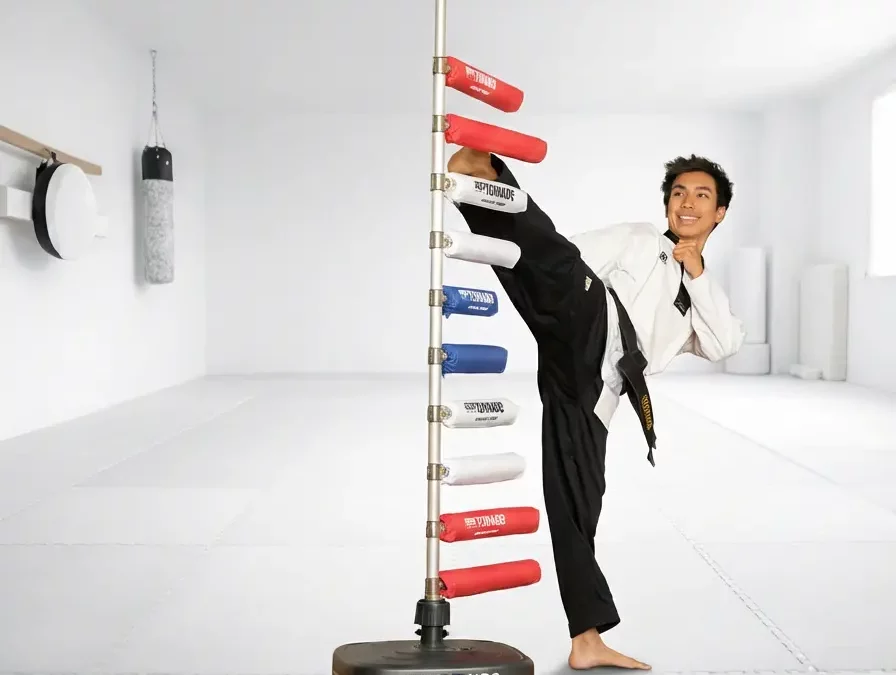
Modern Kick Trainers With a reset mechanism or rotating striking points, you create a different training feel here. They make rounds smoother, demand more of your timing, and help you not only land kicks hard but also with technical precision. For those who want to seriously work on precision at home, this doesn't save time, but rather detours.
The most common mistakes when working out at home
Many advancements fail not due to a lack of talent, but to small technical errors that accumulate week after week. The most common is starting too fast. As soon as kicks are executed quickly before the movement is stable, the focus shifts from the sequence to momentum. This looks explosive but degrades the technique.
A second mistake is a lack of retraction. In Taekwondo, a good kick doesn't end with a hit, but with a controlled return. Anyone who drops their leg after a kick loses balance, their guard, and their rhythm for the next action. Therefore, at home, you should train every repetition as if the follow-up movement would immediately follow.
This is often compounded by an incorrect training focus. Many people work almost exclusively on high kicks. High kicks are impressive, but without a stable base, they have little athletic value. A clean kick at medium height with good form, tension, and timing will get you further than ten uncertain headshots in the air.
The space is also often underestimated. Those who train on slippery floors, with a poor stance, or between furniture unconsciously alter their movements. The kick becomes more cautious, shorter, or more cramped. For serious home training, you don't need a huge room, but enough space for clean technique and a secure stance.
This is how progress becomes measurable
If every repetition looks the same, you're training clean. If every tenth one looks noticeably different, you lack control. Progress in kick training, therefore, isn't just shown in height or power, but in repeatability. If you can execute the same kick with the same technique ten times in a row, your quality increases.
Film single sentences with your smartphone. Not for show, but for analysis. Pay attention to knee chamber, hip rotation, foot position, upper body posture, and pullback. A video doesn't replace a coach, but it removes the illusion that a kick feels clean when it isn't.
Home training becomes even better when the equipment itself provides feedback. Systems that Speed, reaction or focus more strongly on a clean target contact, making progress more concrete. This not only motivates but also sharpens focus. You then train not just more, but more precisely. This is exactly where Solutions like Mudotools makes sense because they make technical training at home more controlled, dynamic, and understandable.
A Realistic 4-Week Training Plan
If you want to learn taekwondo kicks at home, a simple four-week block will often bring you more than constant variety. Week 1 is about basic technique. Slow repetitions, clear chambering, stable stance. In Week 2, you slightly increase the tempo and add simple target work. In Week 3, short combinations are added, such as Ap Chagi followed by Dollyo Chagi. In Week 4, you practice the same routines under a little more time pressure.
The point isn't to do something completely new every week. The point is to be able to execute the same technique under better conditions. First clean, then fast, then fluid. If technique makes the difference, training must start there.
For advanced practitioners, the same plan can become more challenging. Less basic technique, more sets, more two-sidedness, more focus on reaction changes. The opposite is true for beginners. Fewer kicks are better, but better controlled. So it depends on your level, not on some standard plan from the internet.
Training at home is no substitute for good club training. But it's a strong supplement if you set it up correctly. Those who work regularly, with control, and with a clear goal will not only improve individual kicks, but their overall sense of movement. And that's exactly what you'll feel later on the field—in distance, timing, and the confidence of every technique.