
Anyone who wants to kick cleanly usually realizes it quickly in training: strength alone is not enough. The kick might be hard, but not precise. Or fast, but without clean timing. That's exactly why the question of which training equipment is truly useful for kicks is not a minor issue. It plays a role in whether you're just putting in a lot of repetitions or actually improving your technique.
A good training device must match your goal. Do you want to build power, improve reaction, work on distance, or execute kicks more fluidly and controlled? Many train with whatever is available. Punching bag, pads, maybe a striking shield. This works up to a point. But if technique makes the difference, the choice of equipment becomes crucial.
Which training equipment for kicks really helps you?
The honest answer is: It depends on what you want to train. For raw punching and kicking power, a punching bag is still useful. For partner work and variable angles, focus mitts are strong. For targeted kick training with a focus on timing, precision, retraction, and rhythm, both often reach their limits.
In Taekwondo and kickboxing, it's not just about hitting a target. It's about getting into the technique quickly, rotating cleanly, striking at the right moment, and returning to the starting position in a controlled manner. Classic equipment only partially reflects this. That's why a closer look at the differences is worthwhile.
Punching bag - good for toughness, limited for timing
The sandbag is a classic in martial arts. It forgives a lot, is robust, and is suitable for intensive training. If you want to practice combinations, build stamina, and feel the impact of your strikes, it's useful. It can be particularly effective for low kicks, front kicks, or hard roundhouse kicks.
However, his weakness lies precisely where many want to improve their technique. The sandbag moves sluggishly, absorbs energy, and provides only limited feedback on how precise, fast, or clean the kick was. While you hit something real, you often don't train the exact moment of impact. Return movements and working on a smaller, clearly defined target point are also neglected.
This can be problematic for beginners. Those who only train for power too early can easily develop sloppy technique. More advanced trainees notice a different problem: The training becomes monotonous. Many repetitions, little variation, hardly any measurability.
Paws and pads – good with a partner, weaker alone
Pads are valuable in technical training because they are mobile. A coach or partner can change angles, vary distances, and provide direct feedback. This is great for combinations, reactions, and tactical drills. Pads therefore rightly remain a standard, especially in club training.
The catch is obvious. You need a partner who keeps things clean, has good timing, and understands your training level. Poor pad work leads to poor kicks. On top of that, many holders unconsciously compensate. They move towards the kick, rebound incorrectly, or don't provide a clear target. Then you end up training less precision and more improvisation.
For home use, this is hardly a reliable solution. Those who train alone quickly fall out of the rhythm with mitts. This is precisely where the gap between classic equipment and modern kick trainers emerges.
Which training equipment is better for kick technique training?
Once your focus is on technique, the requirements change. Then you don't need a device that simply withstands hits. You need a system that gives you a clear target, keeps the movement fluid, and shows you if the kick was really clean.
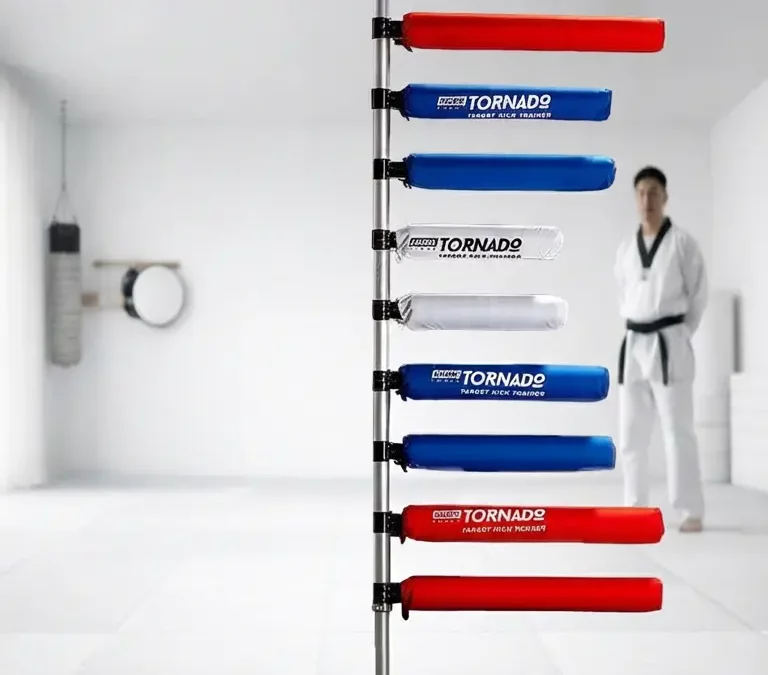
Modern kick trainers provide precisely that. Instead of just offering resistance, they create defined stimuli for accuracy, timing, and rhythm. Swiveling target surfaces, quick rebound, or sensor-based measurement make a difference that you notice immediately in training. Not theoretically, but with every repetition.
A kick to a small, reactive target demands more control than a kick to a large sandbag. You have to approach cleanly, strike correctly, and finish the movement stably. This trains technique much more directly. This pays off especially with roundhouse kicks, sidekicks, axe kicks, or fast combinations with footwork.
What matters in a good kick trainer
A good training device for kicks must achieve three things. It must offer a clear target, react dynamically to impact, and allow for repeatable training. If even one of these is missing, the learning effect suffers.
A clear goal improves precision. Athletes, especially those who want to control their impact height and impact surface, benefit enormously from this. Dynamic reaction is important so that you don't fall into static movements. And repeatability ensures that technique doesn't depend on chance, but becomes trainable.
It gets interesting when a device also measurable, how quickly or cleanly you work. Then you're not just training by feel. You see progress. That's motivating, especially with home workouts without trainer feedback.
This is precisely why modern solutions like Swivel kickpads, magnetic reset or speed measurement are not that good. They turn a simple hit into a technical task. Control begins with technology.
For home or club – the application decides
Not every training device needs to do everything. Different requirements apply to everyday club training than to home training. Versatility is important in clubs. The device should cater to different athletes, sizes, and performance levels. It must be quick to deploy and function consistently even with frequent use.
At home, efficiency is paramount. You want to train effectively without a partner, have minimal setup time, and accumulate real reps that amount to more than just a good sweat. This is precisely where punching bags and focus mitts often lose value. They require space, a partner, or a very clear training structure to prevent workouts from becoming aimless.
A specialized kicking trainer can bridge this gap. It makes solo training technically more demanding and at the same time more motivating. This is particularly relevant for teenagers and adults who want to practice regularly but can't be at the dojang or gym every day.
For beginners, intermediates, and coaches
Beginners most need guidance. A device with a clear impact zone helps to learn movements cleanly. Targets that are too soft or too large often allow inaccurate hits to go unnoticed. Those who work precisely from the start build better automatic responses.
Advanced users benefit more from dynamics and measurability. This is no longer just about fundamentally executing the kick, but about making it faster, more controlled, and closer to competition. A device that supports recoil, rhythm, and direct follow-up movements is significantly more useful for this than static resistance.
Coaches and clubs think a step further. They need training tools that structure group work, make progress visible, and allow for different training methods. If a device not only replaces technical training but also expands it, its everyday value increases enormously.
What many people misjudge when buying
The most common mistake is confusing hardness with training quality. Heavy, massive equipment often appears professional automatically. However, for kick technique, this is only part of the truth. If the target reacts too slowly or doesn't provide clear feedback, you're training strength rather than quality.
The second mistake is monotony. Many devices work on paper but end up gathering dust after a short time because the training becomes too monotonous. Motivation is not a minor issue, especially for home workouts. A device that reacts quickly, allows for variation, and makes progress visible will be used more often. And only used equipment improves technique.
The third mistake is a lack of fit for the discipline. Taekwondo requires different things than kickboxing or karate. Someone who works a lot with speed, hip height, combination kicks, and clean returns needs different stimuli than someone who focuses primarily on striking power.
The most sensible decision for many martial artists
If you're wondering which training equipment for kicks is worthwhile in the long run, you shouldn't start by asking about the most well-known equipment. Instead, ask yourself what you're currently lacking in your training. More power? More precision? Better timing? Cleaner repetitions? Solo training without a loss of quality?
For pure striking power, the punching bag remains useful. For supervised partner training, focus mitts have their established place. However, if you want to specifically work on kicking technique, hit more precisely, kick more fluidly, and track your progress, specialized kick trainers are usually the better choice.
Modern systems, like those developed by Mudotools, pick up where traditional training tools leave off. They make kick training more controlled, dynamic, and measurable. This isn't a gimmick. This is training logic.
In the end, it's not how traditional your equipment is that counts, but how well it supports your goal. If you want every repetition to become clearer, faster, and cleaner, then don't choose the equipment out of habit. Choose it for its effect.