
Those who constantly step too short in sparring or stand too close to their opponent during counters don't have a power problem, but a distance problem. That's precisely why training distance feel in kickboxing is among the exercises that most quickly determine hit rate, timing, and control – in clubs, in competition, and just as much in home training.
Why distance matters so much in kickboxing
Distance perception is more than just the right distance to the target. It connects footwork, reaction, timing, and technique into a split-second decision. You have to recognize when you are outside the opponent's range, when you are entering the strike zone, and how much travel your kick or punch combination actually needs.
Many train technique in isolation. The kick looks clean, the hips are working, the guard is correct. Nevertheless, the hit doesn't land in sparring. The reason is often simple: the technique is right, but the distance isn't. When technique makes the difference, control begins with the distance to the target.
This is particularly tricky in kickboxing because the distance is constantly shifting. A small step backward immediately changes the reach for a low kick, front kick, or roundhouse. Those who can't read this react too late or hit nothing. This not only costs points but also balance and energy.
Kickboxing: Training Distance - What Often Goes Wrong
The most common mistake is monotonous training with a static target. A sandbag forgives a lot. It stays where it is. This helps with power, rhythm, and basic technique, but only to a limited extent with real distance work. In combat, the target moves, the angle changes, and your timing has to keep up.
The second mistake is too little focus on the entry. Many only train the hit, not the path to get there. Often, the first small step determines whether the kick lands cleanly or if you walk into a counter. Distance judgment therefore doesn't arise solely in the moment of contact, but already when reading the situation.
The third mistake: too little feedback. When you train at home without a partner, you often don't notice exactly whether you've operated from an optimal range or just improvised your distance. Progress then remains vague. This is precisely a problem for ambitious athletes and coaches because clean technique training must be measurable and repeatable.
How good distance training really works
Effective distance training requires three things: a clear goal, adjustable distances, and direct feedback. Only when you can regularly distinguish between too short, just right, and too close will a reliable sense of range develop.
In practice, this means: Don't just train straight series, but work with deliberately changing starting points. A front kick from an ideal distance feels different than a front kick after moving backward or after a side step. The same applies to low kicks and roundhouses. The technique remains similar; the distance decision is new each time.
Another factor is timing. Your sense of distance isn't static. It thrives on hitting the right moment. An opponent who turns in, stops, or pushes forward immediately changes the situation. That's why training methods that combine target contact, recovery movement, and reaction work particularly well. This prevents rigid execution and instead creates a fluid sequence.
Drills that noticeably improve your distance feel
A strong start is a simple change of distance with a single technique. Take the front kick, for example. First, start a little too far away, take a small step forward, and land a clean hit. Then, start too close, take a small step back or change your angle, and only then land the kick. This way, your body learns to actively correct distance instead of just reaching it somehow.
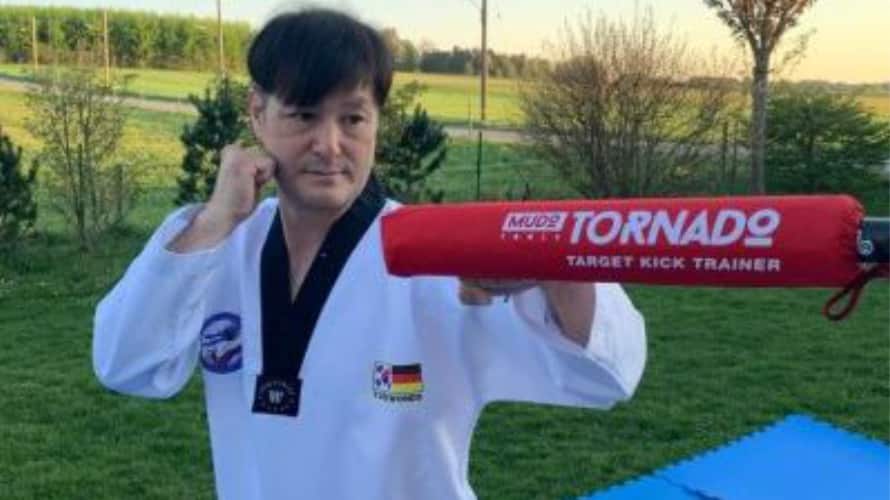
Reaction drills, with a clear reset of the target, are also very effective. If the Target image After immediately returning to the starting position after the kick, you can train in sets without losing the flow of movement. This is especially strong for timing and follow-up shots because you don't have to regroup after every hit.
For advanced practitioners, a drill with two distances in a combination is worthwhile. Example: Jab or feint from long distance, then a kick from medium distance. The reasoning behind this is simple. In a fight, everything almost never stays within one range. Those who train distance sensing must learn to re-evaluate the distance within a combination.
Stop drills are also useful. Cover the distance explosively, stop briefly before the target, and only deliver the kick on the second impulse. This trains control. Those who always go full throttle often develop speed, but not a fine sense of the space in front of the goal.
Train kickingboxing distance without a training partner
This is precisely where ordinary home training diverges from targeted technique training. Without a partner, variable movement is often missing. Nevertheless, you can build your sense of distance very effectively if your training tools allow for dynamic sequences and provide you with a realistic target image.
Rotating or resetting target surfaces are significantly closer to combat practice than a pure sandbag. They force you to have clean timing and help you read the moment of contact more accurately. Training becomes even more intense when Speed or reaction time become visible. Because then you are not only training your feel, but also recognizing whether your distance judgment is becoming faster and cleaner.
This is precisely the advantage of modern training solutions like those from Mudotools. They don't replace an opponent, but they fill a gap that many are familiar with from home training: lack of feedback, static routines, and little control over actual progress. When every hundredth of a second counts, repetition alone is no longer enough.
Which techniques particularly benefit from distance training
Front kicks benefit early on because they rely heavily on linear reach. You quickly notice if you're judging the distance cleanly or if you need to adjust. This makes them ideal for beginners and for precise corrections in technique training.
Roundhouse kicks are more complex. Here, not only distance but also angle play a more significant role. Those who stand poorly to the side often hit unclearly despite good reach. Therefore, distance training for roundhouse kicks should always be combined with footwork.
With a low kick, timing is particularly relevant. If you throw it too early, you'll miss. If you throw it too late, you're often already at the wrong distance. Good low kicks rarely come from a stationary position. They come from movement, from reading your opponent, and from the right moment.
Boxing combinations also benefit. Many people think of kicks first when it comes to distance. In fact, clean punching distance is just as crucial. Those who constantly overextend their arms lose balance and open themselves up to counters. Therefore, distance training should never consist only of kicks.
Here's how to incorporate the topic meaningfully into your training plan
Two short, focused sessions per week often achieve more than one long session without a clear objective. A sense of distance improves with quality, not with blind volume. Work on the physical exertion at the beginning of a training session, when your mind is fresh and your timing is still sharp.
A sensible structure begins with individual techniques at varying intervals. This is followed by combinations with step or angle changes. Finally, reaction drills under light pressure are introduced, for example, on signal, with a time limit, or in short intervals. This keeps the training athletic, controlled, and measurable.
Coaches can manage this very well at the club by consciously setting distances instead of just counting hits. The same applies to individual athletes at home. Set a focus for each training session. Today, only front kick and entry. Next session, angles and roundhouse. Then, reaction and follow-up. This way, a vague feeling becomes a resilient system.
How to truly recognize progress
It's not just about hitting more often. Better distance control is mainly shown in your technique becoming calmer. You have to make fewer corrections, you stand more stably, and you get back into position faster. Hits feel more controlled, not more frantic.
Another marker is your decision time. If you recognize sooner whether you need to advance, stop, or exit, your decisiveness automatically increases. This not only makes you more accurate but also more efficient. You waste less energy on wrong turns.
It's worth its weight in gold for competitors. And equally so for beginners. Because a clean sense of distance prevents bad habits that are difficult to correct later on.
Distance is not a talent you either have or don't have. It is trainable - if you don't leave it to chance. Work precisely, train with feedback, and give your timing a real goal. Then every kick becomes more than just movement. It lands where it's supposed to land.