
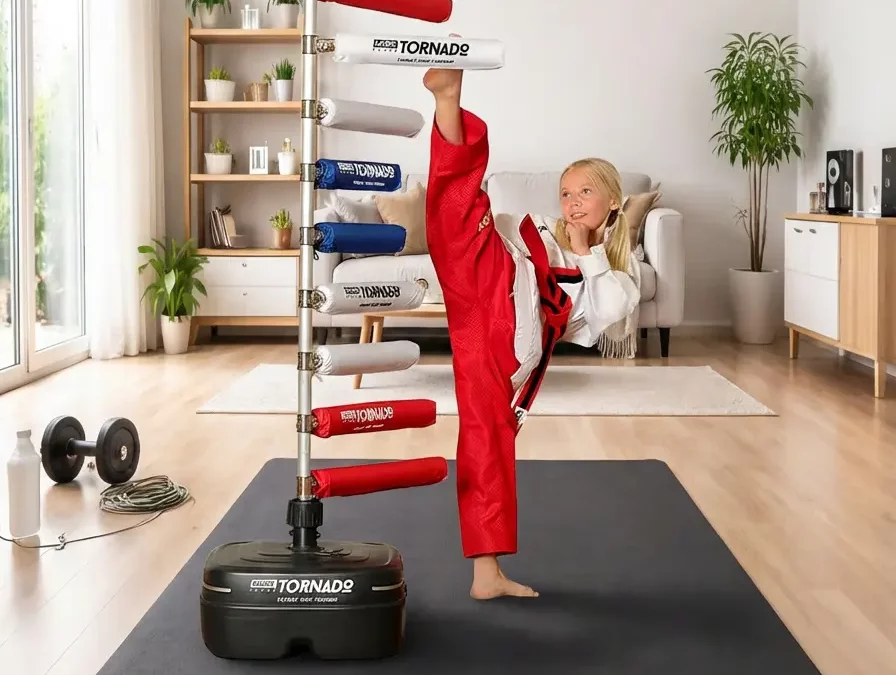
Anyone who wants to improve their kicking technique at home quickly realizes where it often fails: the kick feels powerful, but not clean. The height is sometimes right, sometimes not. The timing is off. And without a training partner, targeted technique training quickly becomes just dull repetition. This is exactly where movement and technique diverge. If every repetition is to count, you need control instead of chance.
Improving kicking technique at home means more than just kicking often
Many people train one thing at home above all else: volume. More repetitions, more sweat, more speed. The problem is that an unclean movement doesn't get better by repeating it often, but rather more ingrained. Anyone who truly wants to improve a roundhouse kick, side kick, or front kick needs to know exactly what is being trained: chambering, hip engagement, stance leg, striking surface, retraction, and distance.
Direct feedback is often lacking at home. In a club setting, a coach immediately sees if the hips aren't rotating or if the standing leg is blocked. This mistake often goes unnoticed during solo home training. Therefore, good technique training at home isn't just a watered-down version of club training. It requires different focal points. Precision, repeatability, and feedback become more important than pure intensity.
Those who understand this will make faster progress. Not because they do more, but because they train more purposefully.
The most common mistakes in home training
The first mistake is too much power with too little control. Many kicks look explosive at first glance but fall apart during the movement. The upper body tips, the guard drops, the kick comes up high but doesn't return cleanly. This costs stability and makes combinations slow.
The second mistake is a lack of target focus. Without a clear target in the area, the kick becomes imprecise. You end up training movement, not striking quality. This is a real disadvantage, especially in Taekwondo and kickboxing. A kick needs not only to be fast, but to hit the right height, the right angle, and at the right moment.
The third mistake is monotonous training. Ten minutes of punching the same kick into the air sounds diligent but often yields less than three clean rounds with a clear objective. Technique improves best when load, reaction, and control come together.
Improve kicking technique at home with a clear structure
When technology makes the difference, your training needs a foundation. Not complicated, but precise. A good workout at home doesn't start at full speed, but with preparation. Mobility in the hips and hamstrings, active warm-up for the stance leg, and some slow technique drills ensure the movement starts cleanly.
After that comes the technique block. This is about individual kicks in a controlled execution. Slow, deliberate, with focus on a single point. Today, perhaps just the retreat after the hit. Tomorrow, the hip rotation. The day after tomorrow, the height while maintaining balance. Those who try to correct everything at once usually don't improve anything for real.
Only then does the transfer into dynamic sequences pay off. This includes, for example, double kicks, kick-kick-hand combinations, or reaction drills with changing targets. This is how a combat-ready technique develops from a clean individual movement. Control begins with technique, but it doesn't end there.
Why air kicks alone aren't enough
Kicks in the air have their place. They help with agility, a feel for technique, and leg control. But they have their limits. Especially when you want to improve timing, distance, and accuracy. Without contact, a crucial part of the movement is missing. The body learns the sequence but not the moment of the actual strike.
The retreat often suffers from this as well. Many kicks appear fast in the air, but become unstable after contact because core tension is lacking at the decisive moment. This is precisely why training solutions with a real target are so valuable. They not only provide visual orientation but also direct feedback on execution.
The classic sandbag can help, but it also has limitations. It absorbs the kick but reacts sluggishly. This isn't always ideal for fast technique training, precise target changes, or fluid combinations. Pads are more dynamic, but usually require a partner. This is often the problem at home.
What home workout equipment really helps
Not every piece of equipment automatically improves technique. What's crucial is whether it fits your goal. If you want to train power, resistance is sensible. If you want to train timing, precision, and recovery speed, you need a target that allows for fast repetitions and doesn't impede the flow of movement.
Especially for martial artists who train without a partner, systems that combine a real target area with direct feedback are strong. Rotating kickpads, quick reset, or sensor-based measurement make a noticeable difference here. They force you to hit cleanly, retract controllably, and maintain a clear rhythm. This is technically more valuable than simply hitting something hard.
A good home setup doesn't have to be large. What's more important is that you can train regularly without having to improvise each time. The lower the barrier, the more consistent the training. And consistency almost always beats activism.
Improve kicking technique at home without a partner
Without a partner, you don't just miss out on holding pads. You miss out on reacting above all. That's precisely why your home training should always include exercises that go beyond mere repetition. Work with fixed target points, changes in height, and clear series. For example, a fast front kick to mid-height, immediately followed by a high roundhouse kick. Or a side kick with a deliberate stopping moment before retraction.
It gets even better if you speed and Measurable precision Because feelings are deceptive. A kick can feel fast and still be slower than last week. It can seem hard and still hit uncleanly. Anyone who wants to see progress needs comparability.
This is precisely where modern kick training becomes interesting. Training equipment that Feedback on Speed or allow for clean repetitions under real-world conditions, bring structure to home training. This not only motivates. It makes development visible. Mudotools focuses precisely on this – with training solutions that make technical work at home more dynamic, controlled, and traceable.
Three focal points that improve things immediately
The first focus is chambering. Many kicks lose quality even before making contact because the knee is not properly prepared. Good chambering determines direction, height, and explosiveness. Train it consciously and not just as an afterthought.
The second focus is the supporting leg. Those who wobble compensate. Those who compensate lose precision. Whether it's a roundhouse or a side kick – the supporting leg controls more than many think. Pay attention to how the foot works, when it turns, and how stable your center of gravity remains.
The third focus is withdrawal. A good kick doesn't end on contact. It only ends when your leg comes back in a controlled manner and you are immediately ready for action again. This moment is crucial, especially in kickboxing and taekwondo. A quick withdrawal means better defense, better follow-up action, and less exposed target area.
This is what a strong 20-minute session looks like
If you have little time at home, you don't need a creative chaos session. You need focus. Start with five minutes of mobility and an active warm-up. Then follow with five minutes of slow technical work on a kick with a clear correction task.
In the next seven minutes, it's going to be dynamic. Short sets, defined goals, clean hits. Don't work until complete exhaustion, but until just before it. Technique suffers when you fall apart completely. The last three minutes are for finishing: controlled repetitions, clean form, calm rhythm.
That sounds unspectacular. But it isn't. Because this is exactly how progress is made, which becomes noticeable in sparring, competition, or club training.
The same does not apply to beginners and advanced learners.
Beginners at home particularly benefit from clear, simple movement patterns. Fewer kicks, but performed cleanly. Height is secondary at first. Stability first, then dynamism. Those who focus only on speed too early build in mistakes that must be laboriously corrected later.
Advanced users, on the other hand, need more variability. Not just clean individual kicks, but transitions, reactions, and different distances. This is less about learning the basic movement and more about fine-tuning. Small differences in angle, rhythm, and recovery tempo then determine true quality.
Coaches see it immediately. Athletes often only later. That's why training at home is worthwhile, not only because it's strenuous but also because it can be specifically observed.
Anyone who wants to improve their kicking technique at home doesn't need a miracle solution or endless equipment. What counts is training that brings together strike quality, control, and repeatability. The clearer your goal, the cleaner your kick. And that's exactly where progress begins, progress that you can not only feel but also see.