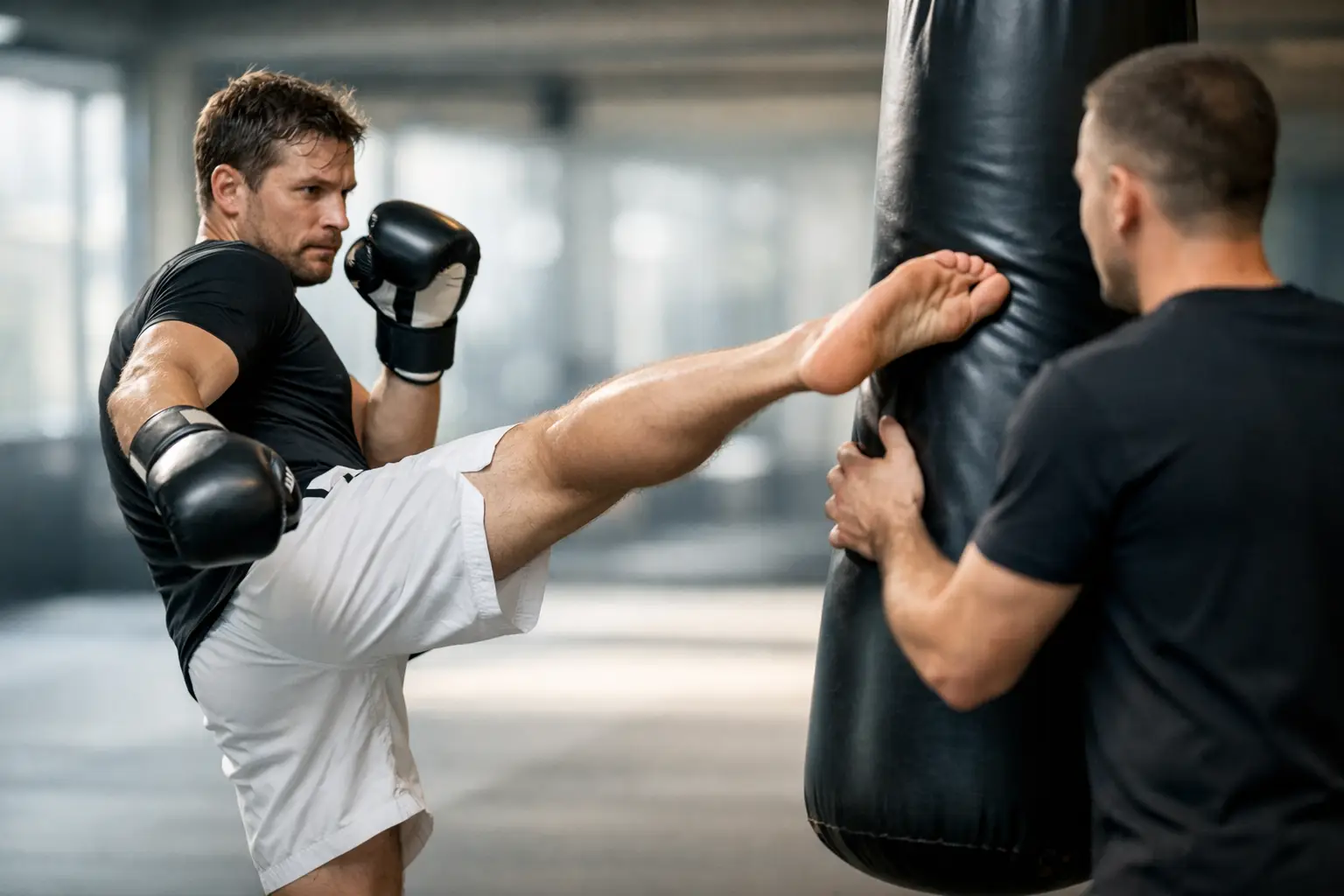
Improve kicking technique

Kick more precisely, avoid mistakes, and specifically build your technique.

Many train regularly but only make slow progress because their kicking technique remains flawed. Often, there's a lack of clear goals in training or an understanding of the correct execution.

This is precisely where the difference lies: If you specifically improve your kicking technique, you'll become not only more precise, but also faster and more controlled. Clean technique is the foundation for effective kicking training, whether in the dojang or at home.


Train your kicks like in real sparring

Why Clean Kicking Technique is Crucial

A clean kicking technique is the foundation for all progress in training. Without control over movement, balance, and timing, you lose power, precision, and speed.

Many underestimate that technology shouldn't just „look good“ but directly influences your performance. A cleanly executed kick is more precise, harder to predict, and can be repeated faster.

Anyone who improves their technique automatically trains more efficiently while simultaneously reducing the risk of incorrect strain and injuries.

Improve Taekwondo Kicks

Master practices kicking training in the dojang

Typical errors with kicks

Most problems don't arise from a lack of strength, but from incorrect movement patterns. Often, kicks are too uncontrolled, without a clear direction or stable body posture.

Typical mistakes include a lack of balance, using force too early, or an unclear hip movement. This causes kicks to lose precision and appear slower than they actually could be.

Also, missed repetitions with a focus on clean execution lead to mistakes becoming ingrained rather than improved.

This is how you improve your kicking technique specifically

The key is to build your training intentionally. Instead of just doing a lot of kicks, you should specifically work on individual movements.

Train slowly and controlled before adding speed. Pay attention to your balance, proper posture, and clean execution from start to finish.

It is also helpful to train with clear goals. Whether it's precision, timing, or control – if you know your focus, you will make faster progress and sustainably improve your kick technique.

Improve Taekwondo Kicks

Master practices kicking training in the dojang

Latest posts for improving kicking technique

Improve kicking technique | Posts
April 19, 2026measure kick speed training How to improve your technique, timing and explosiveness in martial arts kick speed training helps you to objectively improve your kicks. Many athletes rely on their instincts during training - but this is often misleading. A kick can look hard and feel fast, but is actually slower than expected. This is where measurable training becomes crucial. Especially in taekwondo, kickboxing or karate, it's not just strength that counts. It is important how quickly the kick starts, how cleanly it goes through and how controlled it hits the target. If you measure these factors, your training will be more targeted and efficient. Measure kick speed training: why speed alone is not enough A fast kick is not created in isolation. Behind speed are technique, body control, timing and efficient movement. If you just try to kick faster, you often lose precision or stability. Measure kick speed training shows you whether a change really brings progress. If you improve your hip rotation or your stance, you can see it immediately. Progress can be measured instead of just felt. This is particularly valuable for trainers. Specific values can be used instead of general instructions. This creates focus and motivation during training. What are the specific benefits of kick speed measurement training? The biggest advantage is clarity. Many people train with sandbags or claws and hope to make progress. Without measurement, it remains unclear whether anything is really improving. With kick speed measurement training you can recognize differences between: left and right side different types of kicks fresh and tired repetitions This makes training more precise. You immediately recognize where you are stronger and where you need to work on. What factors influence kick speed? Kick speed is the result of several components: Clean technique and movement sequence active hip rotation Stable standing position ability to react quick return movement A kick speed measurement training makes it clear which of these factors needs to be improved. Without measurement, this often remains unclear. Measurement alone is not enough Data only helps if it is used correctly. If you only aim for maximum speed, you run the risk of poor technique. A fast but uncontrolled kick will not give you an advantage in competition. Kick speed training should therefore always be combined with precision. The goal is not just speed, but controlled, clean movement. This is what effective kick speed training looks like Good training consists of clear phases: Technique phase with clean, controlled repetitions Measurement phase with short, intensive series Analysis phase to evaluate the results Example: 3 sets of 5 kicks per side, with sufficient rest between repetitions. This is how you measure real performance and not just fatigue. Measure kick speed training in particular only works effectively if every repetition is performed with high quality. Which training equipment is useful The sandbag is good for strength and load. Pads help with combinations and rhythm. However, both have limits when it comes to measurable training. For precise kick speed measurement training, training solutions with clear target points and direct feedback are much more effective. Devices with speed measurement enable reproducible results and structured improvement. This is a great advantage, especially for home training. Without a training partner, feedback is otherwise limited. For whom is kick speed measurement training useful? This training is particularly worthwhile for: Beginners who want to understand technique more quickly Advanced athletes who want to train more precisely Competitive athletes who want to optimize their performance Trainers who want to structure their training Measuring kick speed training is particularly beneficial when progress needs to be visible and comprehensible. Typical mistakes when measuring Common mistakes in training: Different distances and conditions Excessive fatigue during the measurement Improper technique for better values only training one side Clean conditions are crucial for kick speed measurement training to be truly meaningful. Measurability changes your training If you measure speed, you automatically train more consciously. Every repetition takes on meaning. Progress becomes visible. This is precisely the difference between modern training approaches: Not just training harder, but training in a more targeted way. kick speed measurement training brings structure, control and real development to your training. If you want to know whether you are really getting faster, you need more than just a feeling. You need clear data and clean technique. FAQ: kick speed measurement training Is kick speed measurement training useful? Yes, it helps you to measure your progress objectively and work specifically on your technique and speed. How do you measure kick speed? With special training equipment or sensors that record and evaluate speed and hits. What is more important: speed or technique? Both belong together. Speed without technique brings no advantage. Technique is what makes speed effective. [...] Read more...
April 13, 2026The roundhouse is clean, but the kick is a touch too late. In sparring, that's all it takes to miss. If you want to train fast kicks, you need more than just leg strength. Technique, return movement, timing and training that demands real reactions instead of just blunt repetitions are crucial. This is exactly where diligent training is separated from effective training. Many athletes work hard on the punching bag, but do not automatically become faster. The reason is simple: speed in kicks is not only the result of effort, but also of precise movement. When technique makes the difference, every detail counts. Why fast kicks are not just the result of power A fast kick begins long before contact. Stance, hips, gaze, weight shift and tension in the torso all influence how quickly the leg enters the trajectory. If you just try to kick harder or more frantically, you often lose control. The result is a kick that looks aggressive, but is readable early on or doesn't hit cleanly. This is a typical mistake, especially in taekwondo and kickboxing. Many athletes first think of explosive muscles when they think of speed. This plays a role, but it is not the first lever. If the movement is technically too long, if the knee is not loaded cleanly or the return remains slow, even more strength will only help to a limited extent. Speed is therefore always a combination of efficiency and reaction. A kick becomes fast when unnecessary paths disappear. It becomes even faster if you recognize the stimulus early and the movement can be called up automatically. This is exactly why training must do more than just repetition. Training fast kicks first means: shortening the movement The biggest brake on kicks is often not the leg, but the sequence. Lunges that are too wide, an unstable stance or a lack of body tension cost time. If you want to train fast kicks, you need to look at every phase of the technique. With a front kick, for example, this means: lift your knee quickly, use your hips in a controlled manner, bring your foot directly onto the line and pull it back immediately. With the roundhouse, the path of the knee is crucial. If you first lunge sideways and then pull back, you will lose valuable hundredths. If you guide your knee cleanly, you can work shorter, more directly and therefore faster. The return movement is just as important. Many people only train the way to the target, but not the way back. This is precisely what is critical in competition. A quick first kick is of little use if the leg gets stuck afterwards and you are standing open. Control starts with technique, and this always includes a clean reset. The hips set the pace - or take it away The hips set the pace in almost every kicking technique. If it comes too late, the kick becomes tough. If it turns too early or too big, the movement becomes legible. Good kickers generate speed not by swinging wildly, but through short, precise rotation. This also means that more flexibility is helpful, but not automatically better. Those who are very flexible but cannot control their hips in a stable manner often kick far, but not fast. Conversely, technically clean athletes with normal mobility can achieve very high speeds because their sequences are compact. Timing and reaction are the real accelerators A kick can be biomechanically fast and still come too late. That's why fast kick training always includes a stimulus. A target that appears. A direction that changes. A moment in which you have to make a decision. This is exactly where traditional training tools often reach their limits. You can train power and endurance on a punching bag. Timing works better on the claw, but usually only with a partner. If you train alone or want fluid repetitions with real feedback, you need systems that demand both reaction and technique at the same time. Training equipment with a defined impact area, quick return or measurable speed feedback is strong for this because it not only generates contact but also trains behavior. You don't just see whether you have hit the target. You also notice whether your rhythm is right, whether you were too late and whether your kick comes back in a controlled manner. Why measurable training makes you better faster Many athletes misjudge their speed. A kick feels fast because it is powerful. On the field or in comparison under competition conditions, the picture is often different. Measurability brings clarity here. If you train repetitions under the same conditions and get feedback on your speed, real comparative values emerge. This motivates you, but more importantly, it makes progress visible. Coaches can correct more accurately. Athletes can see whether technical changes actually improve speed or just look different. Mudotools focuses precisely on this point. Modern kick training solutions not only help with hitting, but also with the systematic development of speed, timing and precision - even without a training partner. How to set up training for faster kicks If you want to train fast kicks, you shouldn't just kick 200 repetitions in a row. This makes you tired, but not necessarily faster. It makes more sense to build up in clear blocks in which quality comes before volume. At the beginning is the clean individual movement. This is about technique with low fatigue. Short series with full focus on the starting position, knee path, hips and retraction are more effective than long sets with diminishing control. As soon as the movement runs smoothly, the stimulus change follows. Now a target comes into play, ideally one that reacts dynamically or gives direct feedback. After that, training from movement is worthwhile. A kick from a standing position is the basis, but in a fight you rarely kick from a perfect position. Step in, angle change, preload, kick. This is exactly where you can see whether the technique really works. Finally, you can do a short block with series or intervals to keep your speed stable under load. An example of a strong unit A good session doesn't have to be long. Just 20 to 30 minutes of targeted technique training can achieve significantly more than an hour of sloppy running. Start with relaxed mobilization and active hip work. Then 3 to 4 short technique series per kick, each with a focus on direct execution and fast retraction. In the main part, train towards a clear goal in short intervals, about 5 to 8 seconds of maximum precision and speed, then take a break. This keeps the quality high. In the last block, you combine reaction and combinations, for example a quick kick to start, retreat and direct follow-up kick. The break is important. Speed needs fresh nerves and clean control. If you are completely overloaded, you are training for toughness rather than speed. Common mistakes when training for kick speed The first mistake is too much hardness and too little technique. Those who constantly train with maximum force often change their mechanics. The kick becomes harder, but not faster. Light, direct techniques in particular suffer as a result. The second mistake is monotonous training. Always the same height, always the same distance, always the same rhythm. This makes repetitions comfortable, but not competitive. Speed also comes from adapting to changing situations. The third mistake is a lack of feedback. Without a clear goal, resistance or measurement, much remains a matter of feeling. That's enough for basic training, but not if you want to get faster. And then there's regeneration. Fast kicks demand a lot from the hip flexors, core and stabilizers. If you are constantly training at your limit, you will often become firm rather than explosive. It is worth combining intensive speed units with technical days. Training fast kicks at home - useful or a compromise? For many, home training is not an emergency solution, but the decisive lever. Especially when training partners are lacking or club times are limited, you can work very specifically on kick speed at home. The only requirement is that the training offers more than just free kicks in the air. A good setup at home should allow for three things: a realistic goal, fluid repetitions and some form of control. This is when home training becomes a real performance driver. Solutions that allow you to continue working straight away without repositioning after each contact are particularly useful. This saves time and keeps the movement flowing. For beginners, this means more confidence and clearer technique. For more advanced users, it's about fine-tuning, rhythm and measurable development. Trainers also benefit because exercises become more structured and progress remains traceable. What really makes you faster in the end Fast kicks are not a product of chance. They are created when technique is properly shortened, reactions are specifically demanded and progress is clearly monitored. Strength can help, but it is no substitute for good mechanics. And many repetitions are only effective if they remain precise and controlled. If every hundredth counts, you should build your training in such a way that it prepares you for real combat situations - with clear goals, dynamic stimuli and movements that remain fast, even when your heart rate increases. Then a kick doesn't just feel faster. It actually is. And that's exactly what you notice first in the timing, then in the hit and finally in the whole fight. [...] Read more...
April 10, 2026The kick lands quickly, but not cleanly. Sometimes too low, sometimes too early, sometimes without clear control at the point of impact. This is where you decide whether you are just training a lot or whether you really take kick precision training seriously. Because in taekwondo, kickboxing or MMA, speed alone is of little use if distance, timing and target control are not right. Precision is not a side effect of hard training. It is a skill in its own right. And it doesn't just come from repetitions against the punching bag. Control starts with technique - and technique requires conditions that demand precise work in the first place. This is exactly where structured training with the right kick training equipment comes in. Why kick precision training is more than just hitting the target Many people equate precision with accuracy. A precise kick doesn't just hit - it hits at the right moment, with the right area and from the right distance. This is particularly evident in fast techniques such as the roundhouse kick, hook kick or front kick. If you only go for power, you often lose control. The problem is not a lack of willpower, but a lack of training structure. What's more, precision is closely linked to timing. This is precisely why you should always consider precision training in combination with timing training. Kick precision training: What matters technically If you want to improve your kick accuracy, you need to consider four factors at the same time: Distance, target height, retraction and rhythm. Many mistakes are made before the kick. A wrong stance or poor distance means that you have to correct at the last moment. This costs control and destroys precision. The target height is also crucial. If you regularly train at varying heights, you will automatically improve your body control and the quality of your hits. The retreat is the most underestimated point. A kick is only really clean if you stand stable again immediately afterwards. Why a punching bag and claw are not always enough Sandbags and braces are important. They remain useful for strength, fitness and basic technique. However, they reach their limits when it comes to precision. The punching bag provides resistance, but hardly any feedback on the quality of the hit. With the claw, a lot depends on the partner. For targeted technique training, you therefore need conditions that are reproducible and provide clear feedback. This is where modern training solutions make all the difference. How to set up effective precision training Start with calm series. One technique, one goal, full control. Quality before quantity. In the second step, you change individual parameters such as height or angle. This keeps the training under control but makes it more challenging. Then comes the change of stimulus. Now you combine precision with timing. This is where systems such as the Tornado training device are particularly effective because they combine movement, target changes and feedback. Finally comes the control: Are you hitting cleanly? Are you stable? Does the technique remain correct even under speed? Which drills really help Beginners should work with simple single-target drills. One technique, one target, clean repetitions. Advanced athletes benefit from target changes and combinations. This creates real control while moving. Reaction is crucial for competitive athletes. Here, training systems with moving or quickly resetting impact surfaces offer a clear advantage because they combine timing and precision. Precision training at home without a training partner Precision training at home often fails due to a lack of training quality. Without feedback, it remains unclear whether you are really improving. That's why you need three things: a clear goal, reproducible conditions and direct feedback. This is exactly where modern kick training devices help, because they make training more measurable and controllable. The Tornado system combines these points particularly well because it combines movement, reset and clean hitting surfaces. The most common mistake: too fast too soon Speed looks good. Precision wins battles. If you go for speed too early, you often build up inaccurate patterns. The correct structure is clear: control → rhythm → speed. Clean technique can be accelerated. Poor technique falls apart under pressure. Conclusion: precision is key Training kick precision means making movement controllable. It's not just about hitting the ball, but hitting it correctly. If you want to become more precise, you don't need more training - you need better training. → Discover kick training equipment → View the Tornado training system → Improve your kicking technique → Kick training at home [...] Read more...
April 10, 2026Anyone who often hits a bit too late in sparring knows the problem immediately: the kick is technically clean, but the moment is not right. This is exactly where it is decided whether a technique has an effect or comes to nothing. Improving kick timing therefore does not simply mean kicking faster. It means reading the right stimulus, choosing the right distance and acting at exactly the right moment. Timing is not a minor matter in taekwondo, kickboxing and related disciplines. It is the part of the technique that turns a good movement into an effective strike. Many train strength, height and repetitions. What is often missing is a setup that is designed for reaction, rhythm changes and controlled release. This is exactly where clean timing training begins - often with the right kick training device. What timing really means when kicking Timing is often confused with speed. Of course a fast kick helps. But a fast kick at the wrong time remains a bad kick. Timing consists of several components that work together: Reacting to a signal, judging the distance, initiating the movement without delay and hitting cleanly in the flow of movement. You can see this clearly in competition. The difference between a hit and a counter-attack often lies not in strength, but in a few hundredths. If you start too early, you betray your technique. If you react too late, you only kick into your opponent's cover or retreat. When every hundredth counts, training must close precisely this gap. There is also a point that many underestimate: Timing is not only important offensively. It also improves control in combinations, intercepting movements and changing pace. An athlete with good timing appears calmer, even though he works more dynamically. Why classic training is often not enough The punching bag and claw have their place. They are useful for hardness, rhythm and basic technique. However, they quickly reach their limits when it comes to timing. The punching bag moves predictably or not at all. The claw works strongly via the partner. This can be very good, but depends on experience, focus and repeatability. This is a typical problem, especially in home training. Without a partner, there is no real signal. Without clear feedback, it remains unclear whether the kick just looked fast or really came at the right moment. Many improve their technique visually, but not functionally. This is precisely why classic training is often not enough if you really want to improve your timing. Improve kick timing with clear stimuli Timing improves when training demands concrete decisions. A good drill doesn't just force you to kick, but to kick at the right moment. This requires stimuli that combine a start signal, target movement and feedback. A fixed target is rarely enough. Forms of training in which the target reacts or changes are better. This is exactly where modern systems such as the Tornado kick training device come in, because they combine movement, timing and feedback. Training is particularly effective if you train three things at the same time: gaze behavior, launch reaction and accuracy. Which mistakes slow down your timing The most common mistake is too much preparation. Many athletes visibly load up the kick and lose valuable time as a result. The second mistake is incorrect distance. Even good timing looks bad if you have to constantly correct it. Monotonous repetition can also worsen timing. If every repetition is the same, you are no longer reacting - you are just rewinding. This is how timing training should be structured Good timing training does not start at full throttle. First, the movement must be stable. Then the variable stimulus is added. Only then does the whole thing become faster and more competitive. Single kick before combination Start with individual techniques such as the roundhouse kick or front kick and work specifically on the timing. Variable stimuli instead of a fixed beat As soon as the single kick goes smoothly, change the stimulus. This is exactly how your body learns to react. Control after the hit Good timing does not end at contact. The decisive factor is control afterwards. Improve your kick timing at home without a training partner Timing training is particularly difficult at home. If you train without a partner, you need a system that allows you to react - otherwise it's just repetition. This is the advantage of modern training equipment. Instead of just working against resistance, you train for a clear moment. This is precisely why kick training equipment works much better here than traditional solutions. If you want to train timing specifically, the Tornado training system is currently one of the most effective options because it combines movement, reset and feedback. How you can really recognize progress Timing doesn't just improve because a kick looks faster. You can recognize progress by the fact that you hit more cleanly, work more calmly and land more hits in sparring. For coaches and clubs Efficiency counts in club training. A good timing setup must work quickly and help many athletes at the same time. This is exactly where structured training equipment helps, because it enables independent training and increases the quality of each repetition. Conclusion: timing is key Improving kick timing is no secret. It is the combination of clean technique, clear stimuli and repeatable feedback. If you really want to improve your timing, you don't just need more training - you need the right training. → Discover kick training equipment → View the Tornado training system → Improve your kicking technique → Kick training at home [...] Read more...