
The kick is clean. The technique is right. And yet, you're often a moment too late in sparring. This is precisely where good technical training separates from effective reaction training in combat sports. Those who only repeat movements become more confident. Those who learn to react to stimuli become faster, more precise, and dangerous at the right moment.
In combat sports, strength alone rarely decides. Much more often, the athlete wins who recognizes signals earlier, accurately assesses distances, and can recall the right technique without hesitation. Therefore, reaction is not an add-on module for advanced practitioners. It is an integral part of functional kickboxing training – from beginners to competitors.
Why reaction training in martial arts is more than just being fast
Many equate reaction with pure speed. That's too simplistic. A quick kick is of little use if it comes from the wrong distance or follows the wrong signal. Good reaction training in martial arts combines perception, decision, and movement in one sequence.
It starts with the eyes. You perceive a movement, a command, or an opening. Then comes the selection of the appropriate technique. Only after that is the actual execution. If any of these steps is too slow or imprecise, the entire action loses its effectiveness.
That's exactly why pure shadow boxing or mindlessly kicking a punching bag is only of limited help. Both can improve technique and conditioning. What is often missing is the changing stimulus. No real reaction without a signal. No clean timing under pressure without a variable task.
Where many training methods reach their limit
Pad work is strong, no question. Heavy bag training too. Both methods have their place – but they don't solve every problem.
The appeal of the sandbag is static. The target remains predictable and forgives timing errors. You can work hard without truly taxing your reactivity. With the pad, it becomes more dynamic, but you rely on a partner.
This is a familiar topic for trainers within the club. Not every group is homogeneous. Not every partner delivers clean stimuli. And at home, a training partner often disappears entirely.
This is exactly where specialized training solutions become interesting. Those who specifically want to Improve kicking technique will require a system that meaningfully connects stimulus, movement, and control.
Reaction Training for Martial Arts: What Should Really Be Trained
If you want to improve your reaction time, you shouldn't just train more hectically. What's crucial is which skills you are addressing.
First, visual stimuli. Second, timing. Third, sense of distance. Fourth, clean reset.
Many problems arise precisely here – not with the technology itself, but with the interaction between recognizing and executing. Therefore, good reaction training is always closely linked to structured Kickboxing training at home together.
This is how reaction training is made practical in martial arts
Practical training requires clear stimuli and repeatability. You define a signal and a clear response – for example, a target you must react to immediately.
The crucial point is repeatability. Only when the stimulus is applied regularly can you see progress.
Modern training equipment start exactly here. Rotating targets or Speed measurement Bring feedback into your training.
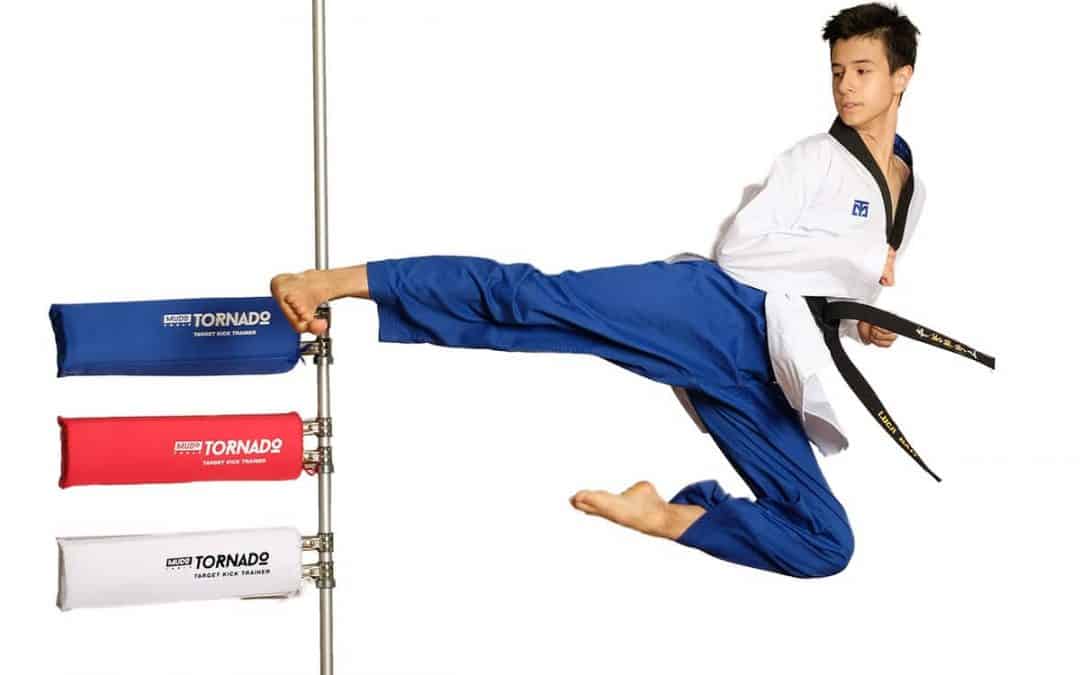
Especially systems like the Tornado training device Connect goal, movement, and timing. This not only trains reaction, but makes it measurable.
Reaction, technique, and control belong together.
In Taekwondo or kickboxing, a fast reaction is worthless if it destroys technique.
If you want to react cleanly, you have to automate the movement sequence. Clean technique first, then speed. Control starts with technique.
This is especially crucial with home workouts. Without feedback, mistakes can quickly creep in. A system with a clear goal structure can significantly reduce this.
Who benefits most from targeted reaction training
Beginners benefit because they learn early to react to stimuli instead of just performing movements.
Advanced players improve their timing. Competitors gain speed at the right moment.
Trainers bring more structure to group exercises.
Common mistakes in reaction training
Too much speed with too little control. Monotonous stimuli. Tasks that are too complex. Lack of structure.
Quality over chaos.
How modern equipment makes the difference
Not every piece of training equipment is automatically better. It depends on the goal.
For toughness, the punching bag remains useful. For technique and reaction, specialized systems are becoming increasingly important.
Mudotools picks up right here – between classic training and modern technical training.
In the end, it's not about simply getting faster. It's about executing the right technique cleanly at the right moment.