
The moment before a hit is short. Very short. In Taekwondo, kickboxing, or karate, if you're too late with your leg, you won't land a clean hit—or any hit at all. That's precisely why leg speed training for martial arts isn't a minor topic, but a real performance factor. Fast legs don't just mean more speed in your kick, but better timing, shorter reaction times, and more control in your movements.
What fast footwork training in martial arts really brings
Many equate speed with haste. That is a mistake. In martial arts, it is not the fastest leg on paper that wins, but the movement that remains precise, repeatable, and callable under pressure. If technique makes the difference, then that's where it shows.
A fast roundhouse kick is of little use if the hip opens too late. A front kick loses effectiveness if the standing leg is unstable. And a fast switch kick is useless if the distance is wrong. Therefore, speed is never isolated. It arises from technique, tension, rhythm, and clean retraction.
This is often underestimated, especially with the legs. Many train strength or stretching, but too little explosive release. Others hit the sandbag countless times without getting real feedback on timing or impact window. This improves endurance. Not speed, automatically.
Martial Arts Speed Training Legs – The Three Real Levers
Those who want to improve their leg speed shouldn't just kick more often. Three levers are crucial: technical efficiency, reactive execution, and controlled recovery.
1. Technical efficiency over brute force
The cleaner the movement, the less energy is lost. That sounds simple, but it's often the turning point in training. A kick becomes faster when the movement becomes shorter and clearer. This affects chamber position, hip line, stance foot position, and recovery after the hit.
A typical example is the Dollyo Chagi, or roundhouse kick. Many people wind up too much or unnecessarily tilt their upper body. This doesn't make the kick more explosive, but slower. Speed is generated here by a direct path of movement. Less wasted motion, more impact time.
2. Reaction instead of just repetition
Speed in combat is rarely planned like in technical drills. Most of the time, you're reacting to distance, movement, or a brief opening. Therefore, training needs to be not only fast but also reactive. The leg must trigger on a signal, not just on command in its own rhythm.
This is where the weakness of many traditional methods lies. On a sandbag, you can build pressure and train toughness. It's only partially suitable for reactive kicking because the target remains static. Pads are better, but often require a training partner and don't always provide consistent conditions. Those who trained without a partner, therefore needs solutions that combine timing and feedback.
Provision determines true speed
The first kick is only half the battle. In competition, what counts is how quickly your leg is back in position – for the next kick, for a feint, or for defense. This is exactly where many athletes lose time. The kick goes out, but the leg comes back sluggishly.
Control begins with technique. Those who actively train their recoil not only increase their striking frequency but also protect their own balance. This is especially important for combinations, alternating kicks, and counter-attacks.
Why classical methods often reach their limits
Punching bags, focus mitts, and pads all have their place. No question. But when the goal is targeted speed training for the legs, their limitations quickly become apparent.
The sandbag forgives a lot. You can work with power, even if the angle isn't clean. There's very little direct feedback for timing and precise release. Pads are more dynamic, but heavily dependent on your partner. If they hold inaccurately, you train inaccurately. If they hold too statically, the stimulus for a real reaction is missing.
A practical problem arises that many are familiar with: Not everyone has a training partner or dedicated indoor court time at all times. Training at home, in particular, can quickly become monotonous. Anyone who seriously wants to develop leg speed needs repeatable routines, clear target points, and ideally, measurable results.
This is how a good speed training program for the legs should be structured
Effective training doesn't rely on maximum fatigue, but on quality with high attention. For speed, it's almost always: short, clean, explosive.
Start with technical individual actions. A kick, a clear distance, full concentration on trigger and retraction. Then comes the next level: same technique on stimulus. For example, on an acoustic or visual signal. Only then are sequences, changes of direction, or combinations added.
Sentence length is also important. If you work for too long at a stretch, you become sloppy. For real explosiveness, short intervals are usually more effective than endless repetitions. Ten seconds of maximum focus often achieve more than two minutes of half-hearted continuous kicking.
Speed training exercises for legs in martial arts
Three types of exercises have proven effective in training. First, the quick single kick to a clear target. Here you train the direct start from the basic stance. Second, double kicks with active retraction. This trains not only the first contact but also the control in between. Third, reaction series, where kick height, side, or technique change spontaneously.
This is particularly valuable for Taekwondo in cut kicks, dollyo chagi, and bandal chagi. In kickboxing, front kicks, roundhouse kicks, and low kick approaches benefit from the same logic. The difference lies less in the method and more in the clean adaptation to the respective technique.
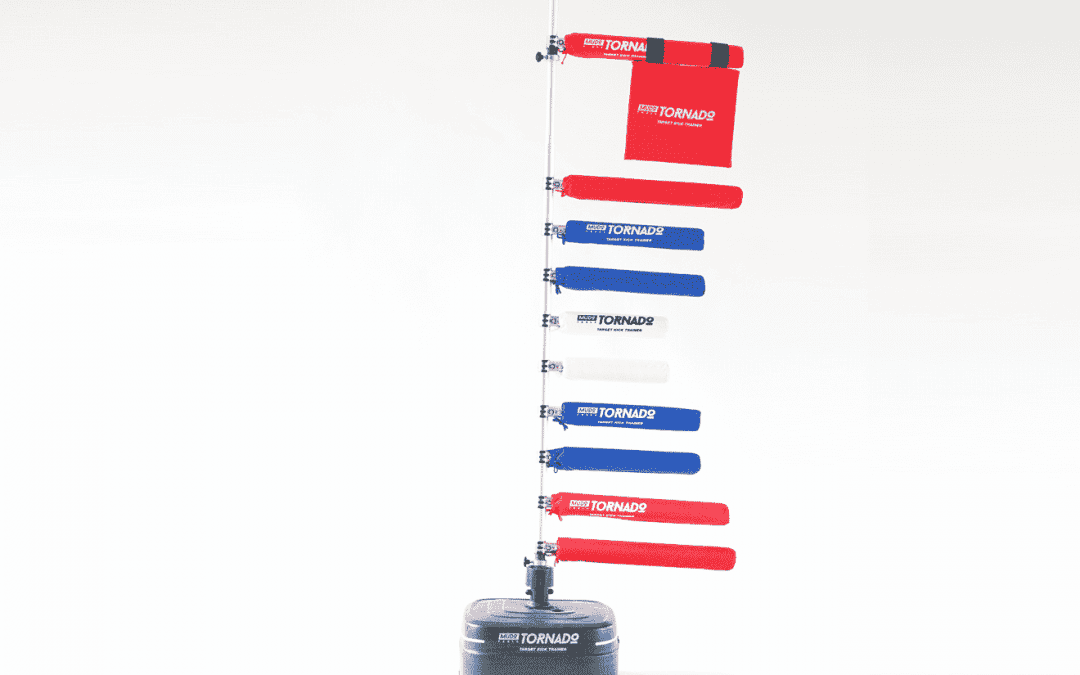
The crucial point is that the target reacts realistically or provides a clear movement cue. Swiveling kick pads, Defined hit zones or systems with quick reset provide significantly more help than a rigid target. This way, you train fluid movement sequences instead of just contact.
Measurability makes progress visible
Many athletes train hard, but unfocused. They feel better, but can hardly grasp their progress. This is particularly problematic when it comes to speed. When every hundredth of a second counts, you need more than just gut feeling.
Measurability changes training. Not because every session has to become a test, but because you recognize what really works. Is your kick triggered faster? Does precision remain at a higher tempo? Can you achieve more clean contacts in the same amount of time? Data like this makes development visible.
This is exactly where modern training solutions play to their strengths. Systems with sensor-based speed measurement orclear reset mechanisms provide a training quality that is difficult to reproduce with conventional methods. This doesn't automatically make them indispensable for everyone. But for ambitious athletes, coaches, and clubs, the difference is clearly noticeable in everyday life.
Technology, reaction, and fun factor must go together
One aspect that is often underestimated in performance training is motivation. Monotonous training is rarely carried out consistently over the long term. Especially young people and those who train at home are more likely to stick with it if exercises are dynamic and provide direct feedback.
This is not a soft factor but a real training advantage. Those who train more frequently with concentration improve faster. Devices that realistically record kicks, reset quickly, and enable different training stimuli bring precisely this dynamic into technique training. Mudotools relies here on solutions that combine precision, timing, and measurable progress in one movement.
Who is suitable for which training
Beginners benefit most from clear target points and clean movement learning. Too much speed too soon often leads to sloppy patterns. Speed should only be built up here once the basic mechanics are in place.
Advanced and competitive athletes can work with changes in stimulation, sets, and metrics much more aggressively. For them, it's not just about whether a kick is fast, but whether it stays fast under load and in combination. Coaches, in turn, need solutions that work for groups yet allow for individual feedback.
So it depends on the level. Beginners train speed in a controlled manner. Those who are more advanced train speed with decision-making. Those who work in a competitive setting train speed under pressure.
The most common mistakes in leg speed training
The biggest mistake is too much strength with too little technique. The leg is moved powerfully, but not quickly. Immediately after that comes too much volume. When quality drops, so does the benefit.
Training without retraining is also problematic. Many only focus on the path to the goal, not on the way back. In combat, that's precisely what costs valuable time. And finally, many train too uniformly. Always the same kick, always the same height, always the same timing. That might make you tired, but not automatically faster.
Better is training that consciously varies but remains technically sound. Less chaos, more clarity. Less randomness, more system.
Fast legs aren't developed from mindless, continuous kicking. They're developed when technique is clean, reactions are trained, and progress remains visible. That's when speed becomes real effectiveness – and a quick kick becomes a kick that arrives at the right moment.