
The roundhouse kick only looks fast and powerful when it's technically clean. This is precisely the difference between a kick that just lands with a loud impact and a strike that truly connects. Anyone who wants to train the roundhouse kick cleanly doesn't just need to hit harder – they need to work more precisely, control the movement sequence, and correct mistakes early on.
Why a clean roundhouse kick often fails
Many athletes don't lack strength, but rather control in transitions. The kick starts well, but during the turn, the stance collapses, the supporting leg remains too stiff, or the hip opens too late. The result is well-known: the kick loses speed, the height isn't right, or the strike lands sloppily with the instep instead of the desired striking surface.
In Taekwondo, Kickboxing, or MMA, it's not enough to know the sequence roughly. When technique makes the difference, every small deviation is decisive. Even a minimally incorrect angle in the stance leg changes reach, balance, and timing.
This is compounded by a typical training problem: You can feel power well on the punching bag, but timing, retraction, and precise targeting often remain unclear. With the focus mitts, much of it works via your partner. At home, this stimulus is completely absent. This is precisely why many athletes need a form of training that combines repetition with control.
Train a clean roundhouse kick – first the mechanics, then the speed
A good roundhouse kick doesn't start in the leg, but in the ground. The standing leg pivots, the hips follow, the knee leads the way, and only then does the lower leg accelerate into the target. Anyone who skips this sequence usually kicks from the thigh. This looks hectic, costs reach, and makes the kick vulnerable to blocks or counters.
It's important to think about the kick in phases. The first phase is clean preparation with a stable stance and relaxed shoulders. The second phase is rotation over the pivot foot and hip. The third phase is acceleration towards the target. The fourth phase is often neglected: the controlled withdrawal. This is precisely where clean technique is evident. A kick isn't finished when it connects, but when you're standing stable again.
Anyone who trains directly at maximum speed will only briefly overlook mistakes. Cleanliness is first achieved at medium speed. Only when the movement is reproducible is it worth increasing the intensity.
The most common technical errors
The most common mistake is not rotating the standing leg enough. This causes the hip to block, the kick remains short, and puts unnecessary strain on the knee and lower back. Almost as common is the upper body tilting sideways. A slight counter-balance is normal, but if the body sways instead of working with the movement, the axis is lost.
Gaze control is also underestimated. Many people look away briefly when turning or lose focus on the target. This immediately impairs distance and precision. Control begins with technique – and technique often begins with details that get lost in fast-paced training.
Clean repetitions beat clumsy repetition counts
A hundred kicks per side sounds diligent. But if fifty of them are technically flawed, you're training the mistake along with it. That's frustrating for advanced practitioners, and even more critical for beginners. The body doesn't store the good intention, but the repeated movement.
Therefore, it makes more sense to work in clear sets. For example, ten technically clean kicks per set, a short break, then a new set with a changed focus. One round focuses on the standing leg and hip, the next on retraction and balance, the third on accuracy. This keeps the training focused and measurable.
Just now in home training This is crucial. Without coach correction, your setup needs immediate feedback. A target that registers movement, resets cleanly, or demands timing will help much more than simply kicking into the air.
This is how you really train timing, distance, and precision in a practical way
A roundhouse kick doesn't work in combat in a vacuum. You need a sense of distance, the right timing, and a clear target. This is exactly where classic methods quickly reach their limits. The punching bag stays where it is. The air gives no feedback at all. And with the focus mitts, a lot depends on your partner.
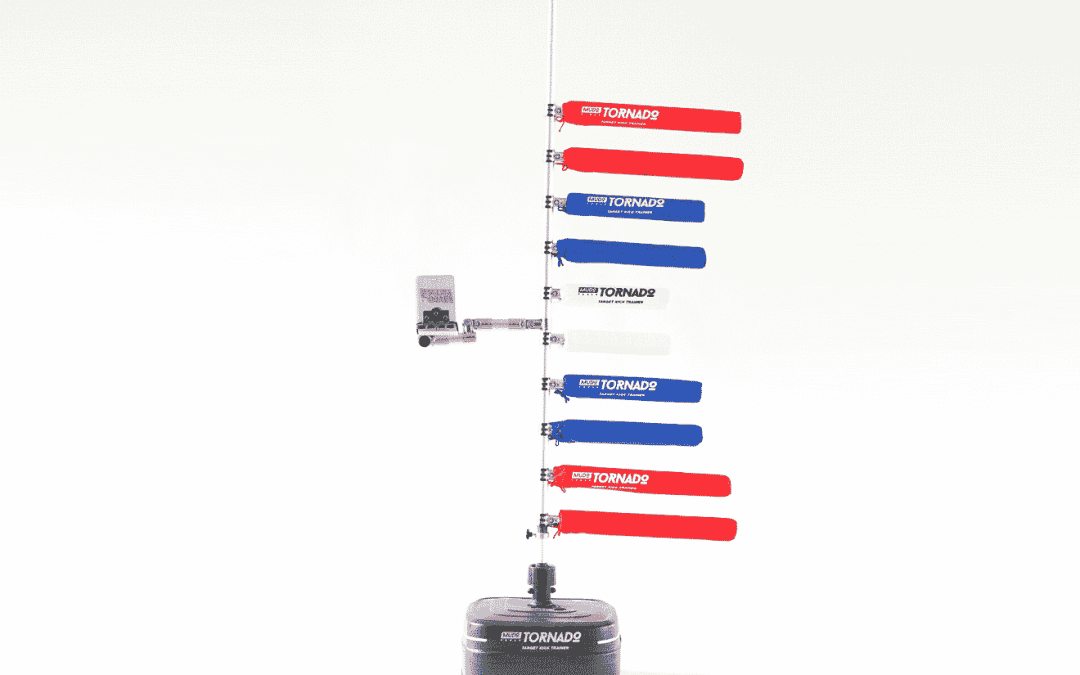
The training becomes practical when the kick hits a realistic target and you can still work smoothly. Rotating or resetting striking surfaces are particularly strong here because they don't slow down the flow of movement, but rather support it. This is more than just comfort. It helps you not only to land the kick, but to execute it with clean technique and immediately return to position.
For coaches, this is worth its weight in gold for the club, as multiple athletes can work with clear stimuli. For home is almost even more important. Those who train without a partner need solutions that bring reaction, rhythm, and accuracy into one unit.
How to train a roundhouse kick cleanly at home
At home, it's often not motivation that's lacking, but training quality. You can do mobility exercises, shadow box, and repeat kicks. But if you're not connecting your punches, not working on distance, and not getting direct feedback on your movements, progress often remains slower than it could be.
That's why it's worth structuring your home training not only by intensity but also by training effect. A sensible block starts with slow technique drills, then moves on to controlled strikes, and ends with short intervals on speed or reaction. This way, you develop not only form but also application.
Modern kick training solutions, such as those offered by Mudotools, focus precisely on this. They make technical training more controlled, dynamic, and understandable. This is particularly powerful when you train without a partner but still don't want to sacrifice precision, timing, and measurable progress.
An effective training plan for beginners and advanced trainees
Beginners should first learn the roundhouse kick through clear, partial movements: stance, pivot, hip, knee, striking line, retraction. Not everything at once at full speed. Those who go for power too early often build tension in the wrong places and lose the natural flow.
Advanced martial artists benefit more from varied stimuli. This means not just the same kick from the same distance, but switching between medium and long distances, between a static start and a moving start, and between a single kick and a follow-up. This transforms technique into a resilient competitive movement.
The target level also needs to be appropriate. High kicks look good, but if the hip isn't working cleanly for that height yet, the line suffers. A low or middle roundhouse kick can be technically more valuable than ten sloppy head kicks. It depends on the skill level. Quality over show.
What measurable progress in a roundhouse kick really means
Many judge their kick by feel. It seems faster, harder, or looser. That's not without value, but it's often imprecise. Measurable progress is better demonstrated by repeatable precision, stable balance after the hit, shorter recovery time, and clean timing over multiple sets.
When every hundredth of a second counts, a vague impression is no longer enough. Then it becomes relevant how consistently you hit the same height, how quickly you get back into cover after the kick, and whether your routine remains stable even at speed. That's exactly what separates diligent training from real technical development.
Sensory or clearly defined target systems can make a real difference here. Not as a gimmick, but as a direct correction tool. You’ll see faster if you’re actually becoming more efficient or just training harder.
Mobility, stability, and recovery are not secondary concerns.
A clean roundhouse kick requires flexibility in the hips and hamstrings, as well as stability in the standing leg and core. Anyone who only works on height without being able to hold the position will compensate with their upper body sooner or later. Then the kick will be higher, but not better.
Short mobility routines before technical training help to free up movement. Even more important are stable basics afterward: controlled holding positions, slow retreats, balance on the plant leg. This may seem unspectacular, but in practice it often brings more than another hard set when tired.
Regeneration is also part of it. If the hip flexors are tight, the back is tired, or the supporting leg is overloaded, the technique automatically suffers. Not every day is suitable for maximum speed. Sometimes a day focused on clean technique is the faster way forward.
How to tell your roundhouse kick is getting cleaner
You don't just recognize progress by the power of your strikes. Your kick comes from the same line reproducibly. Your hips open clearly without you having to throw your upper body away. You hit more securely at a defined height. And after the hit, you are not open or unstable, but immediately ready to work again.
Another good sign is that the kick feels lighter, even though it's getting faster. This isn't a contradiction. It shows that the force is no longer working against your own body, but is flowing through the movement.
That's ultimately what it's all about: not training as spectacularly as possible, but in such a way that every repetition makes your kick better. Those who train the roundhouse kick cleanly don't just build a more beautiful movement sequence – but a kick that works under pressure.