
Combat sports training without a punching bag
How to Improve Reaction Time, Timing, and Kick Precision in Training
Martial arts training without a punching bag means not giving up, but often more targeted training. If your goal is better kicks, clean timing, and more control, the punching bag isn't always the best solution.
Anyone thinking about martial arts training without a sandbag often initially thinks of less intensity. No heavy equipment, no classic punching feel. But this is exactly where the crucial difference begins: Instead of just building strength, you can specifically work on technique, precision, and reaction time.
Why martial arts training without a punching bag can be useful
A sandbag forgives a lot. It hangs statically, takes hits, and offers resistance. This is beneficial for stamina and toughness. For clean kick training, the reality is different. Many movements feel powerful but are technically messy.
At/On/Upon Martial arts training without a punching bag The focus is on control. You recognize more quickly whether your movement is correct, whether your distance is right, and whether your timing is truly clean.
Technique over Power: The Decisive Difference
A clean kick doesn't come from power alone. Line, hips, and striking surface determine quality. During training without a sandbag, it's immediately apparent if your technique is correct – because you can't simply compensate for mistakes with power.
Especially for beginners Martial arts training without a punching bag Therefore, extremely valuable. But advanced players also benefit from regularly isolating and specifically improving techniques.
Improve timing and return movement
A good kick doesn't end with the hit. It only ends when you're stable again or can immediately initiate the next attack. This is precisely where many athletes lose quality.
In martial arts training without a sandbag, you don't just train the kick, but the entire sequence: strike, withdrawal, balance, and follow-up movement.
Precision instead of mere repetition
Many repetitions do not automatically mean progress. Fifty kicks on a punch bag can feel good, but often lead to little technical development.
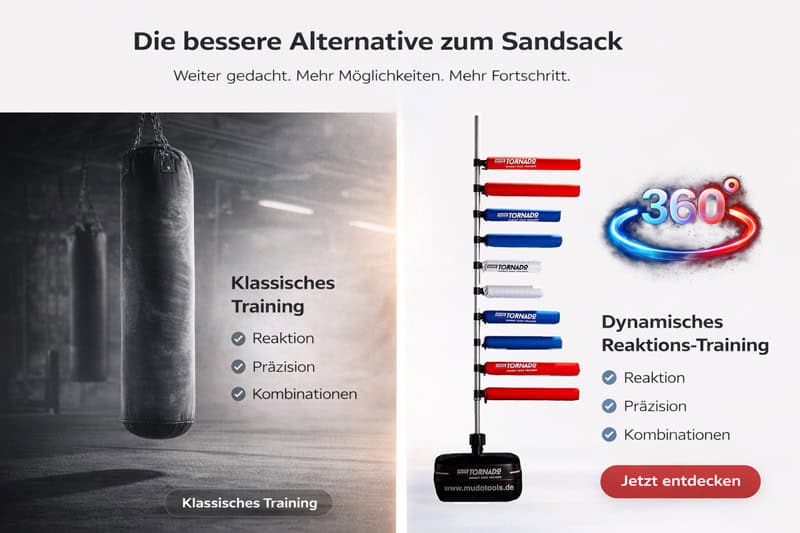
Martial arts training without a punching bag forces you to be more precise. Smaller targets or dynamic training equipment make mistakes immediately visible and significantly improve your accuracy.
Martial arts training without a punching bag at home
A punching bag at home is often impractical: too loud, too heavy, takes up too much space. This is exactly where martial arts training without a punching bag shines.
You can specifically work on technique, reaction, and timing – without a training partner and without elaborate setup. The training will be more structured and efficient.
Instead of just building strength, you are specifically training movement quality, accuracy, and frequency. That's exactly what makes the difference in the long run.
Which alternatives really work
Not every alternative is sensible. Air kicks alone are not enough to develop real timing. Improvised solutions rarely provide clean feedback either.
Effective martial arts training without a sandbag requires:
- clear objectives
- Movement or reaction
- Repeatable processes
Fitness equipment with dynamic goals - how rotating kick pads enable exactly that. They combine technical training with realistic stimuli.
Who martial arts training without a punching bag is ideal for
Combat sport training without a punching bag is especially useful for:
- Beginners who want to learn clean technique
- Advanced individuals who want to improve their precision
- Athletes who train at home
- Trainers who want to build structured technical training
Training in a club can make martial arts training significantly more efficient without a punching bag. Station training becomes more targeted and progress becomes visible faster.
Measurability brings real progress
Many train hard, but not measurably. They feel progress, but cannot clearly track it.
In martial arts training without a punching bag, you can specifically work on speed, precision, and reaction time. As soon as training becomes measurable, the quality of each session automatically increases.
This is exactly where modern training systems come in: they make progress visible and training more structured.
This is how martial arts training without a punching bag becomes truly effective
What's crucial isn't whether you train with or without a sandbag. What's crucial is your goal.
If you want better kicks, you should focus on technique, timing, and control. Martial arts training without a sandbag often provides better conditions for this.
Plan your training deliberately
- work with clear objectives
- Train series under time pressure
- pay attention to clean return movements
- Switch between technical and race pace
This is how simple training becomes real development.
Anyone who takes martial arts seriously shouldn't ask if martial arts training works without a punching bag. The crucial question is: Are you really training what makes you better?
FAQ: Combat sport training without a punching bag
Is martial arts training without a punching bag effective?
Yes, martial arts training without a sandbag is particularly effective if you want to improve technique, timing, and precision.
What's better than a sandbag?
For technical training, moving targets or reactive training equipment are often better suited than a static sandbag.
Can you train at home without a punching bag?
Yes, martial arts training without a sandbag at home is ideal for specifically working on movement quality and control.